
At The What If, we’ve spent a lot of time reflecting on the core problem we’re trying to solve.
Again and again, our conversations brought us back to the concept of polarization.
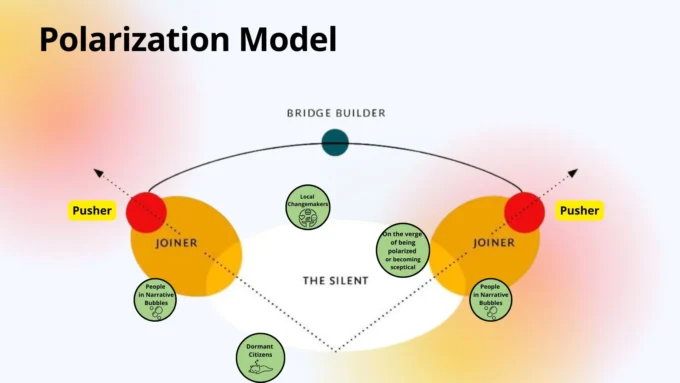
At its core, polarization is the division of people into two sharply contrasting groups of beliefs or opinions. But there’s more to it.
The Polarization and Social Change Lab (PASCL) at Stanford University explores two types of polarization: attitudinal and affective.
Attitudinal polarization is about policy views. Affective polarization is the tendency for partisans to like their own fellow partisans and to dislike their opposing parties.
In other words, attitudinal polarization refers to differences in people’s positions or views, while affective polarization describes the mutual dislike or emotional divide between different societal groups.
Research in the US has shown that affective polarization is growing, not because people like their own party more, but because they started to like the opposing party much less.
Outside of the US, the peacebuilders we interviewed from all over the world shared that they witnessed the widening of this emotional gap.
They spoke about how extreme narratives and mutual aversion between groups make it harder for them to create shared spaces for dialogue, even when people’s fundamental needs are actually not that far apart.
This is where we believe innovation is needed.
Most peacebuilding efforts focus on positions or policy. But affective polarization gets to the heart of what’s breaking down the social fabric.
So we asked ourselves: Why not make it a measurable part of our peacebuilding impact? How can we better understand how people relate to one another across divides? And how can we design more effective interventions based on that understanding?
We’re now embedding indicators of affective polarization, such as social aversion, into our methodology: tracking how people perceive “the other,” (on a spectrum from positive to negative), what language they use, what biases and narratives are shaping their views.
This helps us better understand when and why a community struggles to find common ground, tailor our peacebuilding activities accordingly, and measure the extent to which our work is helping to rebuild trust across divides.
Disagreement is natural, and often necessary. But when it turns into dislike and dehumanization or even violence, peacebuilding becomes harder, slower, and sometimes impossible.